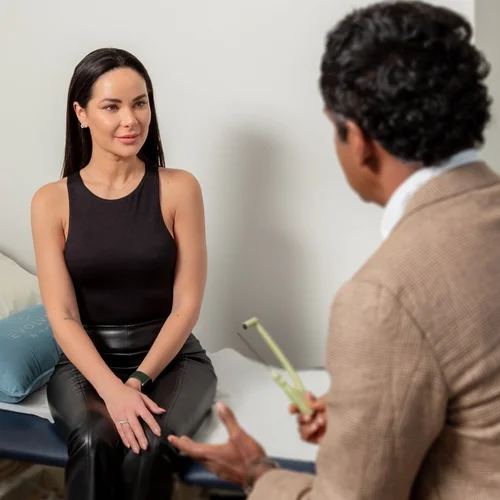
Breast Implant Consultation
to Find Your Ideal Size and Profile
COSMETIC BREAST SURGERY
What we offer
At Norwest Cosmetic Surgery we offer a range of cosmetic breast procedures, tailored to your anatomy and your preferences. Breast augmentation with implants is one of our core procedures, and it can be performed on its own or combined with a lift or fat transfer. There is no single “best” approach — only what is appropriate for you, which is decided together at your consultation.
01
Breast augmentation
Adding volume, fullness or balance using breast implants.
02
Augmentation with a lift
Implants combined with a mastopexy where there is sagging.
03
Fat transfer
04
Implant exchange or removal
YOUR DOCTOR

Dr Senthil Supramaniam
MBBS (UNSW)
Fellow, Australian College of Cosmetic Surgery & Medicine
THE PROCEDURE
What breast augmentation involves
Breast augmentation is a cosmetic surgical procedure that places breast implants to change the size, shape or balance of the breasts. It is performed as day surgery under general anaesthesia in an accredited day hospital, with a specialist anaesthetist caring for you throughout. Most people go home the same day with a support garment and clear aftercare instructions. For some people, the same goals can be approached with fat transfer instead of, or alongside, an implant.
- Where can the implant sit?
Implant position is one of the choices discussed at consultation. An implant can sit above the muscle, partly under it (dual plane), or under it — each suiting different tissue thickness, activity levels and goals. Tap an option below to see a simple cross-section.
Above the Muscle (Subglandular)
The implant sits in front of the chest muscle, behind the breast tissue. It can be a shorter recovery for some patients and may suit those with sufficient natural tissue coverage.
Dual Plane
The implant is positioned partly beneath the pectoral muscle and partly beneath the breast tissue, offering a balance between implant coverage and breast shape.
Under the Muscle (Submuscular)
The implant is placed beneath the pectoral muscle, providing additional soft tissue coverage and a more gradual upper breast contour.
- Round or anatomical implants?
| Consideration | Round | Anatomical (Teardrop) |
|---|---|---|
| Shape | Even fullness, top and bottom | More fullness low, gently sloped upper pole |
| If it rotates | Appearance is unaffected | Rotation can affect shape, as the form is directional |
| Surface | Available smooth or textured | Has relied on a textured surface to hold position |
| Often suits | Those wanting more upper-pole fullness | Those wanting a sloped, tapered contour |
- Silicone or saline implants?
| Consideration | Silicone gel | Saline |
|---|---|---|
| Feel | Generally feels more like natural breast tissue | Can feel firmer; rippling may show more in thin tissue |
| If it ruptures | Cohesive gel tends to stay in place; rupture may be "silent" | Deflates noticeably as the body absorbs the salt water |
| Insertion | Available smooth or textured | Pre-filled, so needs an incision large enough for the implant |
| Monitoring | Periodic imaging recommended (see long-term safety) | Routine rupture imaging generally not required |
In Australia, silicone implants are the more commonly chosen option. Neither is universally “better” — the right choice depends on your tissue, frame and what matters most to you, and is made together with Dr Supra.
A NATURAL ALTERNATIVE
Fat transfer to the breast
Fat transfer uses liposuction to collect fat from another area — such as the abdomen or thighs — which is processed and placed into the breast. For some people it offers a subtle, natural change in shape without an implant, and it can also be combined with an implant in a “hybrid” approach: an implant for volume and structure, with fat used to soften edges and improve tissue cover.
Honest limitations
- The volume increase per session is modest compared with an implant.
- Some transferred fat is naturally reabsorbed, so more than one session may be needed.
- You need enough donor fat to harvest.
- It will not lift a breast that has significant sagging.
WHEN VOLUME ALONE ISN'T
ENOUGH
Augmentation with a lift
An implant adds volume, but it does not lift a breast that has descended. Where there is sagging (ptosis) — often after pregnancy, breastfeeding or weight change — adding volume alone can look bottom-heavy. In these cases an augmentation mastopexy combines an implant (or fat) with a lift that repositions the breast tissue and nipple to a more youthful height.
The degree of sag is assessed using a recognised grading system, which helps decide whether a lift is needed and which lift pattern suits you. Because it combines two procedures, augmentation mastopexy is more complex than a straightforward augmentation, and in some people it is safer to stage it across two operations.
- What is the internal bra?
In selected cases, an internal support technique — sometimes called an “internal bra” — uses sutures or a supportive scaffold inside the breast to reinforce the pocket and help hold tissue or an implant in position. Despite the name, it does not replace a normal bra; it adds internal structural support that can help maintain shape and position over time. It is not needed for everyone, and whether it adds benefit depends on your tissue quality and the procedure planned.
TECHNIQUE &
SAFETY
How safety is prioritised
The 14-point plan
A published checklist of surgical steps designed to minimise bacterial contamination of an implant during surgery — careful skin preparation, antibiotic measures, minimal handling, and protecting the implant from contact with skin. Reducing contamination is thought to lower the risk of complications such as capsular contracture (hardening of scar tissue) and is part of broader implant-safety practice.
The Keller Funnel
A sterile, single-use sleeve that allows an implant to be delivered into the pocket using a “no-touch” technique, so the implant has minimal contact with the skin on the way in. This reduces handling and helps keep the implant clean — supporting the same goal as the 14-point plan: a lower contamination risk.
WHEN VOLUME ALONE ISN'T
ENOUGH
What to expect afterwards
- The first few days involve tightness, swelling and limited arm movement — this is expected.
- Many people return to desk-based work within roughly one to two weeks.
- A support garment is usually worn for around six weeks.
- Strenuous activity, heavy lifting and upper-body exercise are usually limited for several weeks.
- Implants often sit high at first and gradually settle into a softer, more natural position over weeks to months.
Follow-up care
LONG-TERM
SAFETY
BIA-ALCL & implant monitoring
- What is BIA-ALCL?
Breast Implant-Associated Anaplastic Large Cell Lymphoma (BIA-ALCL) is a rare cancer of the immune system — it is not breast cancer. It has been associated almost entirely with textured implants; no case has been reported with smooth implants alone. When it occurs, it usually develops several years after surgery (on average around 7–10 years), most often as a delayed fluid swelling around the implant, and sometimes as a lump. Importantly, when found early it is generally very treatable. The message is awareness, not alarm — see your doctor promptly if you notice new swelling, a lump or a change in a breast.
- Caring for your implants over time
Breast implants are not designed to last forever, and may need removal or replacement at some point. Sensible long-term care includes:
- Stay aware: get to know your breasts and report any new lump, swelling, pain or change.
- Silicone implants: periodic imaging (ultrasound or MRI) is recommended to check for "silent" rupture — commonly a first scan around 5–6 years after surgery, then every 2–3 years.
- Saline implants: routine rupture imaging is generally not required, because a rupture is usually obvious.
- Keep records: in Australia your implant details are recorded with the Australian Breast Device Registry.
Implant imaging is separate from routine breast cancer screening — continue any breast screening recommended for you.
YOUR JOURNEY
The consultation process
We place great emphasis on transparency about the potential outcomes of breast surgery. Your consultations are an opportunity to ask questions and share your goals openly, so a comprehensive plan can be made for your individual circumstances.
1
Two comprehensive consultations
Before surgery you have two consultations with Dr Supra, who explains the procedure, its benefits, costs, risks, complications and the recovery process, and devises a treatment plan suited to you.
2
A cooling-off period
In line with the guidelines, a cooling-off period of seven days applies after your second consultation before a surgery date can be booked — so you are never rushed into a decision. A referral may also be required.
3
Your surgery day
Performed as day surgery under general anaesthesia in an accredited day hospital, with a specialist anaesthetist. You go home the same day with aftercare instructions.
4
Follow-up & aftercare
Our post-operative nurse provides instructions and arranges your dressing change and follow-up appointments to review your healing.
RISKS, COMPLICATIONS &
RECOVERY
Understanding the risks
All surgical and invasive procedures carry inherent risks and potential complications. It is important to be well informed, and we recommend seeking a second opinion from a qualified health practitioner before proceeding. Known risks associated with breast surgery can include:
- Changes in nipple or breast sensation, breast pain, and asymmetry of the breasts or areola
- Capsular contracture (firmness from scar tissue), implant displacement and implant rupture
- Bleeding, post-operative infection, blood clots, and complications related to the heart and lungs
- Discoloured or keloid scars, slow or poor wound healing, skin or fat necrosis, and wound separation
- Numbness or sensory changes, persistent pain, swelling or fluid accumulation
- Risks associated with general anaesthesia
Important: breast implants are not guaranteed to last a lifetime, and future surgery may be required to replace one or both implants. Pregnancy, weight loss and menopause can also influence the appearance of augmented breasts over time.
For the full list of risks, complications and recovery information, please visit our risks, complications & recovery page, and discuss your individual risks with Dr Supra at your consultation.
MAKE A BOOKING
Request a consultation
The Norwest team is ready to provide attentive care for your individual needs. Share a few details and our patient coordinator, Eliza, will be in touch to arrange your consultation with Dr Supra.
Consultations are a paid appointment, and a clinical assessment is needed to determine whether surgery is suitable. We won’t pressure you, and your details are never shared with third parties for marketing. This page contains content intended for audiences aged 18 and over.
FREQUENTLY ASKED QUESTIONS
Breast augmentation FAQ
The following answers are general. A consultation with Dr Supra is still recommended to answer them based on your personal circumstances.
Yes. It is performed as day surgery under general anaesthesia in an accredited day hospital, with a specialist anaesthetist. Most people go home the same day.
An implant adds volume and can improve fullness and balance, which may indirectly improve the look of mild sagging in some people. It does not truly lift a descended breast — where there is meaningful sag, a lift (mastopexy) combined with the implant may be needed. This is assessed at your consultation.
Recovery varies. In general terms, many people return to desk-based work within about one to two weeks, a support garment is worn for around six weeks, and heavier activity is limited for several weeks. Implants settle over weeks to months. Incision lines typically fade over 6–12 months or longer.
Silicone gel generally feels more like natural breast tissue, while saline deflates obviously if it ruptures and may allow a smaller incision. In Australia silicone is the more commonly chosen option. Neither is universally better — the choice depends on your tissue, frame and goals and is decided with Dr Supra.
Many people can breastfeed after augmentation, though some experience reduced nipple sensation. If you plan to breastfeed in future, let Dr Supra know at your consultation so it can be considered in your plan. It's also worth speaking with your doctor or a lactation consultant for the latest information.
BIA-ALCL is a rare cancer of the immune system — not breast cancer. It has been associated almost entirely with textured implants and usually appears years after surgery as a delayed fluid swelling around the implant. When found early it is generally very treatable. The sensible response is awareness: see your doctor promptly if you notice new swelling, a lump or a change.
Implants are not lifetime devices and aren't guaranteed to last forever, so an exchange or removal may be needed in future — for health reasons, a change of size or model, or other concerns. For silicone implants, periodic imaging is recommended to check for silent rupture. If you have concerns about timing, speak with your doctor.
Every plan is different, so quotes are customised and provided during your consultation rather than as a headline figure. A customised quote is confirmed in writing, and may include Dr Supra's fee, facility (hospital & theatre) fees, anaesthesia fees, prescriptions, medical tests and a post-surgery support garment. We don't run discounts or promotions on surgery.
Talk with your doctor first. As a general guide, light exercise may begin around 1–2 weeks post-op, moderate exercise around 3–4 weeks, and moderate-to-strenuous exercise around 5–6 weeks. Limit swimming and exposure to excessive heat and UV for around six weeks.